Life Cycle Benefit Assessment
LCA
We have established the Eco-positive Life Cycle Benefit Assessment (LCBA) Platform. It offers exciting new initiatives including LCBA methods, datasets and project starter kits for business and industry, and LCADesignStudio for students, interns and practitioners.
LCBA extends the reach of negative LCA of loss and impacts that stops at zero (nothing lost or gained). It reaches to assess positive benefits like oxygen generation and rain harvesting, soil biota creation, species richness and ecosystem enrichment. It enables practitioners to go beyond LCA that ends at no net gain to objectively measure eco-positive design and development.
To learn more and contribute to LCBA concepts or research initiatives read our WIT press paper in July 2020, a poster on Novel EPDs from SETAC in 2019, two of our posters from SETAC in Brussels in May 2017. Or there are our third party certified EPDs for a range of products including for Garbage Chute E-Diverter, Particleboard flooring, laminates, toilet paper, reclaimed sand and recycled aggregates.
Recent Research
Selected peer-reviewed and open-access work by Evah researchers.
Third-Party Certified EPDs
- Elephant Foot E-Diverter and Chute — EPD (2017)
- Laminex Particleboard Flooring — EPD ISO 14025 (2018)
- Laminex Redback — EPD ISO 14025 (2018)
- Laminex Termite-Treated Particleboard Flooring — EPD ISO 14025 (2018)
- Blucore Building Sand — EPD ISO 14025 (2018)
- Blucore G5 Filling — EPD ISO 14025 (2018)
- ABCO Toilet Tissue — EPD ISO 14025 (2018)
Background
As well as reducing loads on its finite carrying capacity a sustainable world needs its inhabitants to apply operations that benefit, and grow natural capital and repair its finite carrying capacity. There are many tools for measuring unsustainable development including Life Cycle Assessment (LCA), the International Standards Organisation Environmental Management System method designed to reduce industrial pollution and resource depletion which are negative burdens rather than positive benefits.
LCA has no methodology for analysis or assessment of systems' eco-positive outcomes — for example that may include capacity for oxygen generation, fresh and ground water absorption, ecosystem and species richness and habitat recovery. Instead it can consider oxygen depletion, water consumption, ecosystem depletion and habitat loss. Counting that moves away from loss to gain is outside the current scope of LCA because it lacks the reach to assess moves into and across positive domains.
Aim
The aim is to generate discourse and creation of new quantitative methods for eco-positive development.
Scope
While the focus here is on LCA, the author argues the same principles are applicable to a range of approaches currently used to assess or reduce negative outcomes of unsustainable development. Theoretical and practical transitions are the key to transforming the scope of negative perspectives into viewpoints society needs to stand in to be able to sight and then discern positive outcomes. Sustainability practitioners need new applications and capability to assess benefits, power to create traction in, discretion to ensure gains, capacity to increase reach of, and drive to impel development towards eco-positive outcomes. To reinforce opinion and qualitative argument such outcomes must be objectively assessed, distinctly clear, physically attainable and quantitatively investment worthy.
Introduction
Because it is designed to model, analyse and assess negative impacts of systems as well as improvement and proximity to zero burden goals and benchmarks along the way, LCA can only assess the lack of rather than the growth of real sustainability.
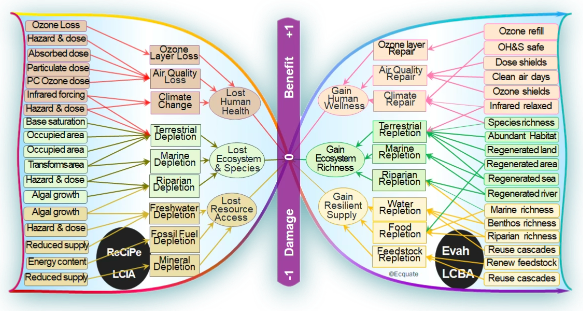
Figure 1, the LCBA butterfly matrix, lays out this gap. The left wing maps the negative side that conventional Life Cycle Impact Assessment (LCIA) covers — impact and capacity loss, terminating at zero. The right wing maps the positive side that LCBA reaches into — benefit and capacity gain across community health, ecosystem replenishment and resource viability. Since all positive outcomes sit outside LCIA range, LCIA has no scope to go beyond zero in approaching positive sustainability.
Positive Path and Ways
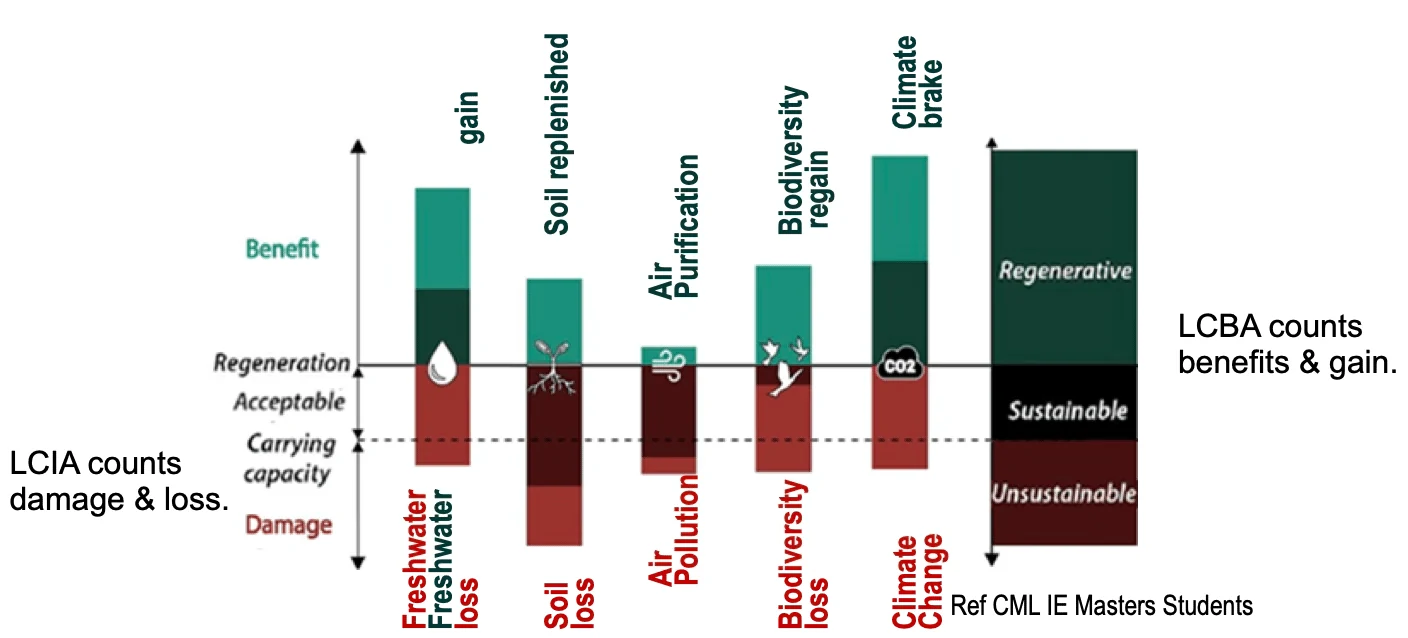
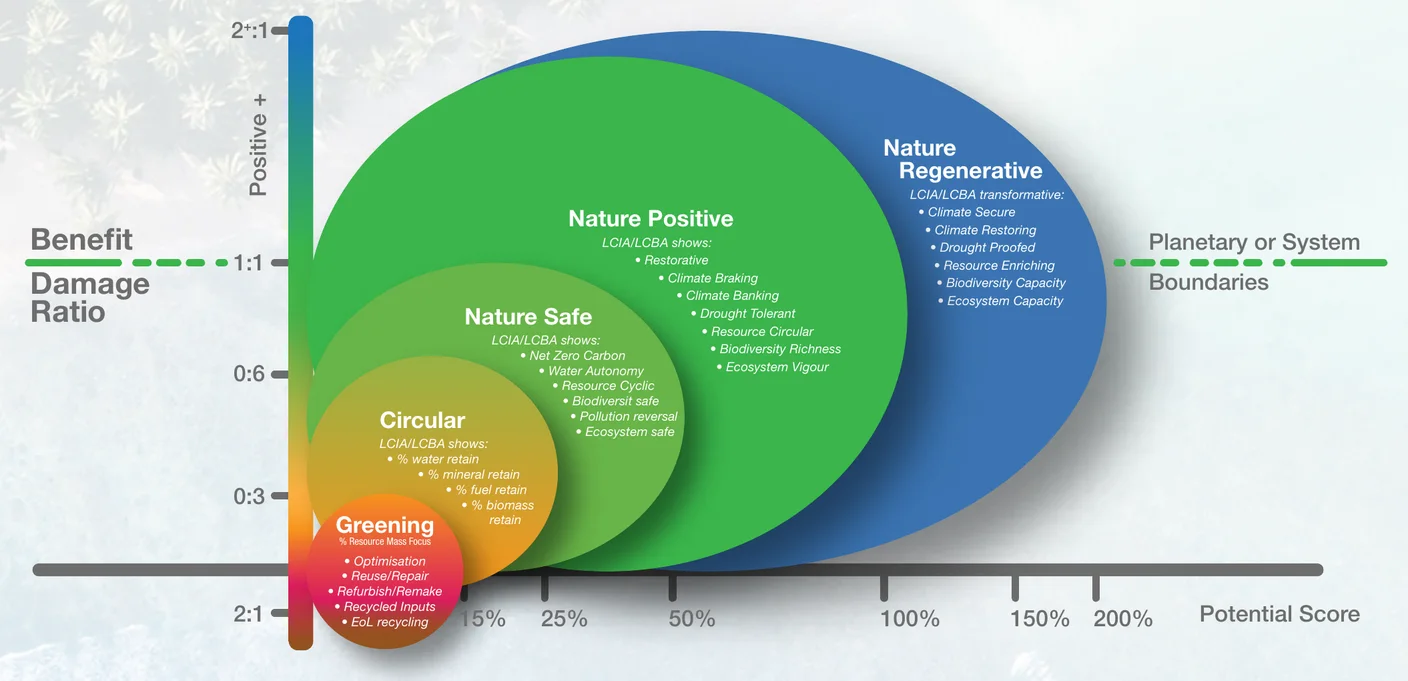
An LCA concept is needed to model, analyse and assess positive benefits as well as improvement and proximity to regenerative and full-benefit goals and real benchmarks along the way. This is essential for defining sustainability theory, research, models and practice. For example positive benefit is depicted on the sphere in Figure 1 across green to blue zones with some yellow fringe. Blue-tip development lines are from zero to points between +1 development (benefit) and +1 capacity (gain).
Life Cycle Benefit Assessment
LCBA is one key to access, quantify and report tangible benefits to be gained from eco-positive development outcomes as well as to discern investment required to achieve such goals. LCBA metrics have been conceptualised for:
- Hale Community Health Years — i.e. human, flora and or fauna
- Positive Ecosystem Replenishment and Supply
- Energy & Resource Viability
Community Health considers populations' needs to restore and improve health after environmentally induced illness, disability and morbidity such as listed as benefit layers in Table 1, in units of Health Adjusted Life Years (HALY).
Ecosystem Replenishment considers ecosystem species, population size or geographical distribution as listed in Table 1 below, in units of positive ecosystem replenishment fraction per square metre (PERF·m²/yr) per year for ecosystem, habitat, biodiversity plus built and urban eco-capacity.
Energy and Resource Viability considers increased renewable and cycling material supply essential to a community as in Table 3, in units of surplus energy and resource viability (SERV·MJ/capita GFA).
| >1750 Benefit Layer | From exposure to | Unit pa | Score >0 <100% (local) | Score >0 <100% (global) |
|---|---|---|---|---|
| Hale Human Adjusted Life Years (HALY*) — local pp pa / global pp pa | ||||
| Quality Air Indoors | Healthy Oxygen | HALYIAQ | kg O2eq & PM101750 | kg O2eq IAQ |
| Fresh Air Access | Organic Safe | HALYfresh | VOC1750 & 1,4-DB1750 | VOC1750 |
| Clean Air Access | Inorganic Safe | HALYclean | kg O2eq & PM101750 | kg O2eq AQO |
| Safe Water Access | Potable Water | HALYpotable | kg rain & 1,4-DB1750 | kg rain |
| Climate Brake | Carbon Sink 20yrs | HALYclime | kgCO2eq1750 sink | kgCO2eq 1750 sink |
| Food Safe | Nourishment | HALYnourish | UN kg organic intake | UN kg organic export |
| Community Security | Shelter & access | HALYurban | Nurse@<1km | Nurse@<10km |
| Positive Ecosystem Replenishment Fraction (PERF*) — 1750/m²pa / >1750/Ha pa | ||||
| Climate Brake100year | Retained Ecosystem | PERFecos | Ecosystem intact | Ecosystem gain |
| Habitat Security | Expanded Habitat | PERFhabitat | Habitat intact | Habitat gain |
| Disaster Security | Food & Water Stock | PERFsecure | Calorie & MI stock | UNcalorie & MI kits |
| Urban Security | Expanded Habitat | PERFurban | Urban habitat | Urban gain |
| Species Security | Species Richness | PERFspecies | Species recovery | Species richness |
| Biodiverse Stock | Terra & Aqua Stock | PERFdiverse | Flora fauna stock | Flora fauna surplus |
| Aquatic Stocks | Restock Aquatic | PERFaqua | Aquatic stock | Aquatic surplus |
| Supply Energy & Resource Viability (SERV*MJsurplus) — 1750 pp pa / >1750 pp pa | ||||
| Resource Recyclate | Recycle Resource | SERVresource | kg Resupply in | kg Feeq |
| Resource Recovery | Recover Resource | SERVreused | kg Reuse out | kg Feeq |
| Quality Recovery | Retain Technical | SERVquality | kg Grade in | kg Feeq |
| Water Catchment | Local Surplus | SERVrain | MI Raincatch | MI rain |
| Fuel Renewal | Biofuel Reliance | SERVbiofuel | MJ Biofuel in | kg oileq |
| Energy Renewal | Renew Energy | SERVenergy | MJ Renew in | kg oileq |
| Material Biomass | Renew Feedstock | SERVbiomass | MJ Biosupply | kg oileq |
| Community Supply | Food Autonomy | SERVfood | MJ Food km | km UNeq |
Table transcribed from the low-resolution capture of the original site — subscripts and units are flagged for Delwyn to verify before publication.
To learn more about LCBA please email info@evah.institute.